arde para volver
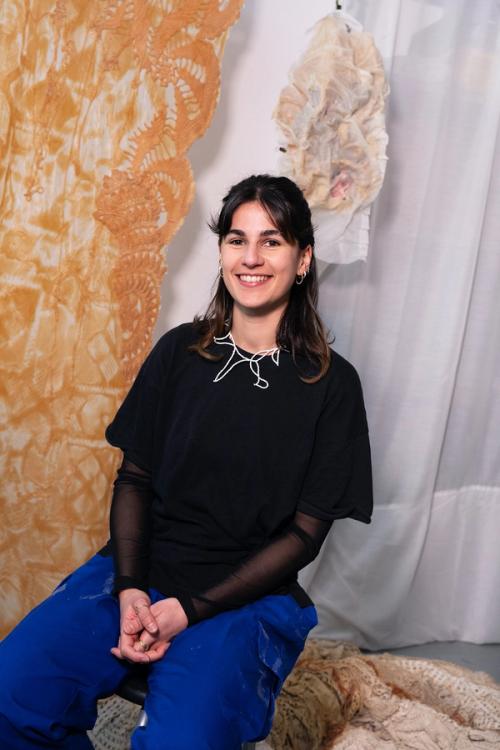
Solo show by Maya Pita-Romero
arde para volver
Solo show by Maya Pita-Romero
8 September - 17 October 2026
On a hot and sticky afternoon in July, I went to Maya’s studio with Javi to see the process that would eventually give rise to the exhibition we can now see at Galería El Chico. As soon as the visit began, she apologised for not yet being able to articulate in words everything we were looking at together. There was something about those pieces that seemed to call for another way of approaching them. At first glance, a cluster of gestures emerged as tentative, undefined attempts, charged with hunches and suspicions. A hand that scratches, grasps, combs; something that coils, something that hangs, something that opens and closes, something that conceals and reveals.
Maya started telling me about the gum rockrose. I love it when stories have flowers and plants as almost central protagonists, in the recurring manner of Greco-Roman myths or folk tales from different cultures. Maya looks at the rockrose and, through her attention to it, shares with me the intuitions that have taken her from one place to another, gradually building stories around them.
The gum rockrose (Cistus ladanifer) is characteristic of the warm, dry, siliceous soils of the Sierra de Madrid, where Maya spent part of her childhood. An apparently fragile plant, with white, wrinkled flowers, like cigarette paper, whose individual blooms last only briefly, yet which, taken together, transform the landscape into something that appears snow-covered. Its petals are marked by five reddish spots, which have given it one of its most popular names: the five-wound rockrose.
The rockrose is resinous and flammable. It is linked to fire and poor soils, to survival and shepherding. It burns easily and, at the same time, the heat from fires facilitates the germination of its seeds. It burns in order to return. It is precisely where the landscape seems to have been destroyed that it can most easily come back. As we write this text, the western Sierra of Madrid is burning mercilessly.
There is another story about the rockrose that is particularly fruitful for Maya. Its resin produces labdanum, an aromatic substance that was used for centuries in perfumes, incense and medicinal preparations. Maya shares with me the fascinating image of an old, oversized comb, a rudimentary tool used to extract labdanum from the tangle of the rockrose scrub. Traditionally, labdanum could also be collected from the wool of sheep and goats, which, while grazing among the rockrose bushes, would become coated in the sticky substance. There is something in this object and in these gestures that condenses many of the questions running through her practice: the relationship between human and non-human bodies, between care and extraction, between tenderness and violence; but also between knowledge and experience. A form of knowledge that emerges from the hands, from the repetition of a gesture, from observing what happens when one body comes into contact with another.
In the images Maya shared with me throughout the process, there was an open mouth, forced apart by hooks holding its edges so that its interior could be observed: the teeth, palate, tongue, tonsils, uvula. In another, an animal’s body appears partially shaved so that a wound can be stitched. In another, hands are wrapped in strips of white material, crossed by arrows and annotations. Later, one hand holds a sticky substance between the index finger and thumb; around it are syrups, sweet syrups and candies. And in another open mouth, hands perform the gesture of stretching it apart while, inside, there is a flower, a sprig of herbs and a pair of scissors. The mouth thus becomes a strange place: organ, opening, wound, entrance, exit. A place where the bodily and the vegetal, the medicinal and the domestic, nourishment and surgery become entangled.
It is no coincidence that the titles of Maya’s earlier works repeatedly invoke the mouth, the tongue, the body: sin nunca llegar a la boca, mil caricias saben a golpe, Una lengua cansada, desde dentro parece que brota algo, lamer un tallo cortado, marañas que lamen mi piel. In them, there is an insistence on knowing through the body, before language organises experience.
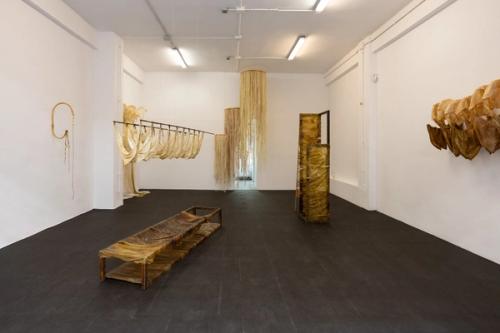
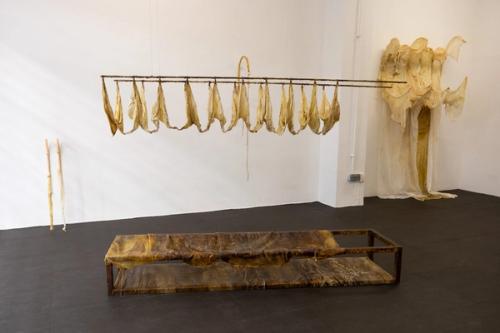
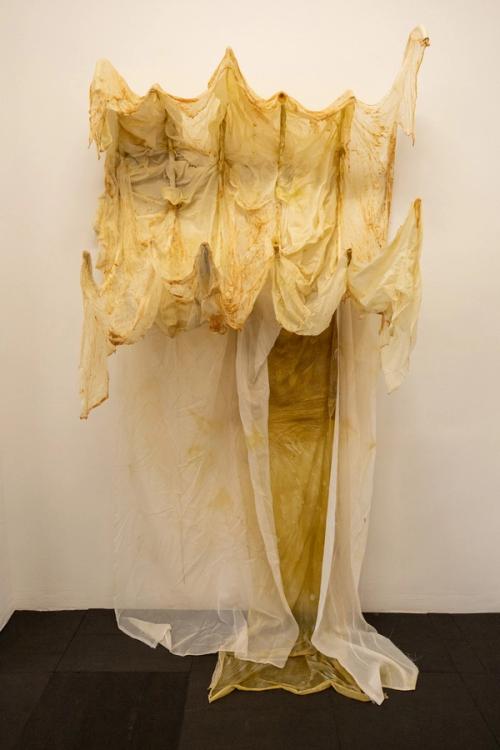
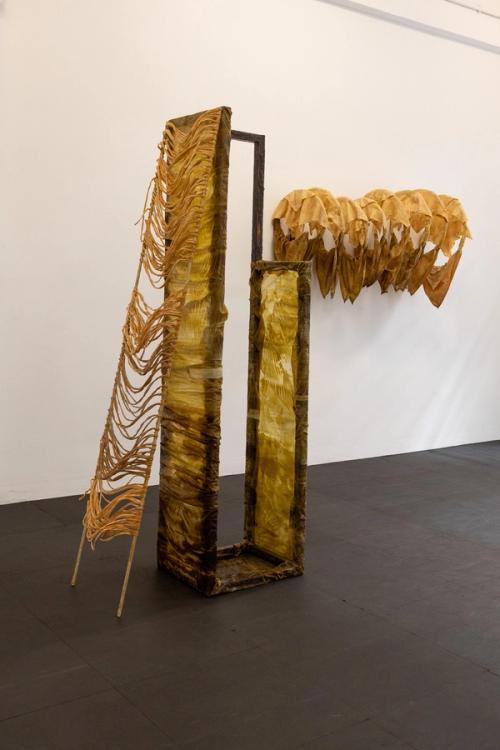
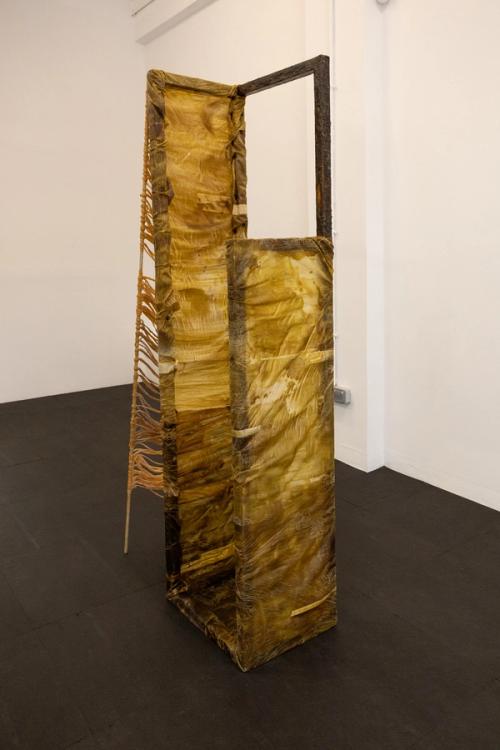
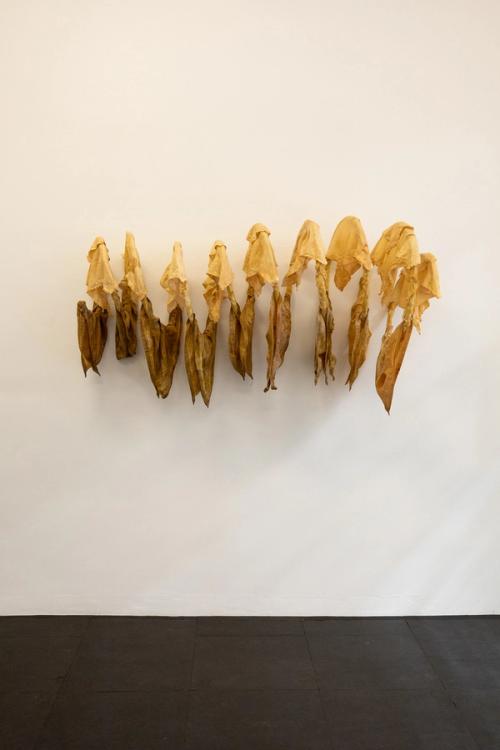
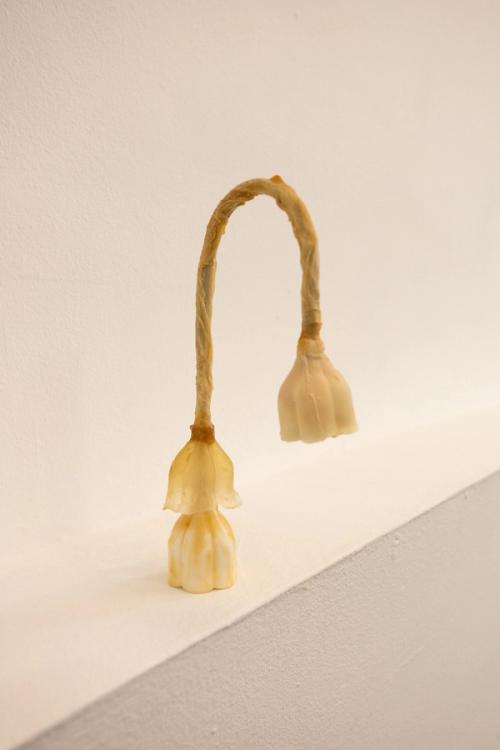
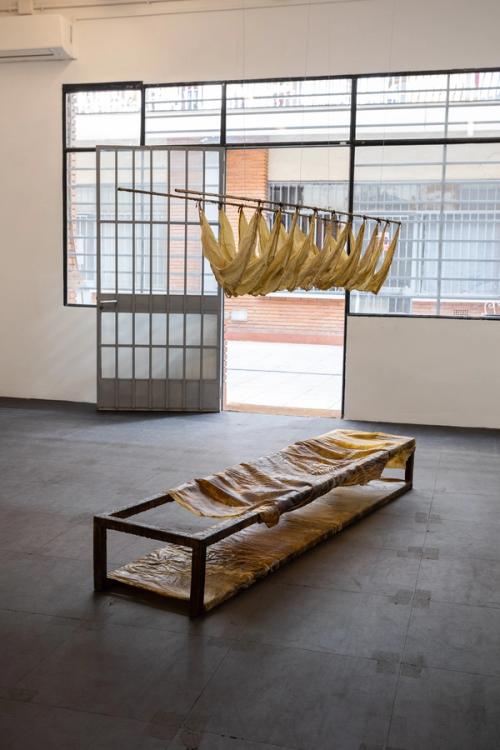
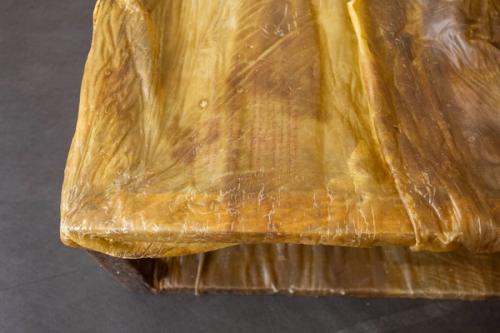
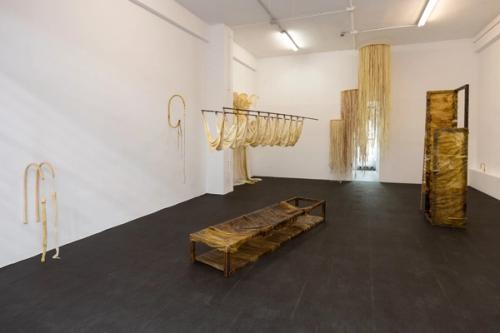
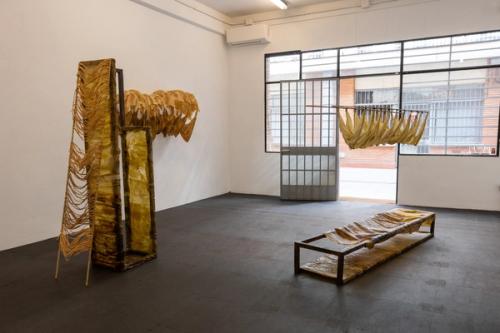
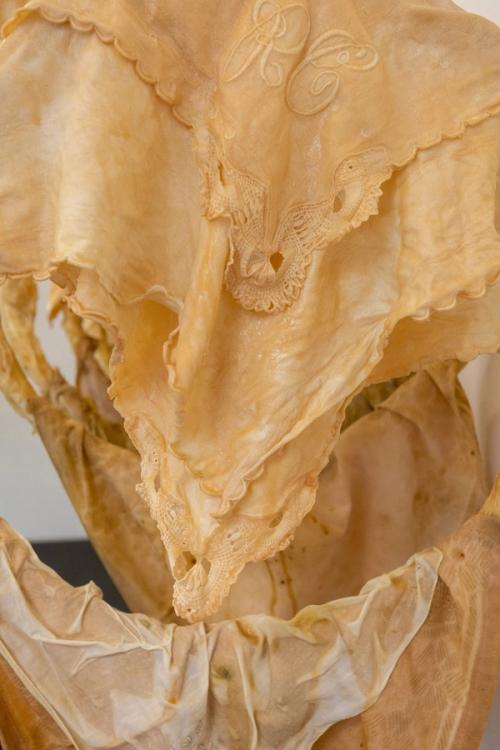
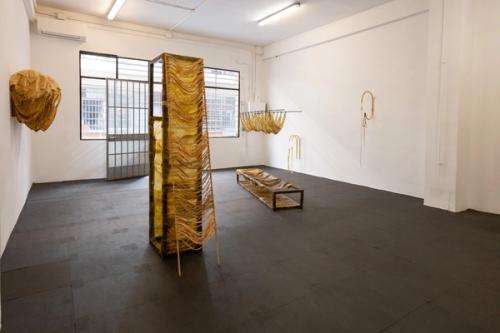
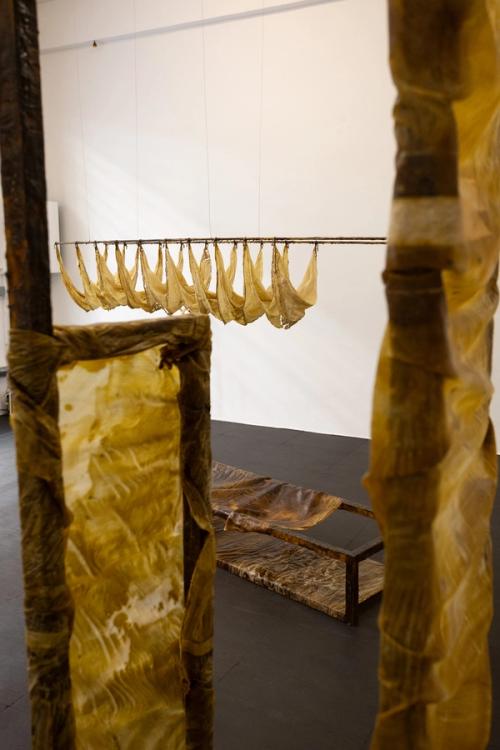
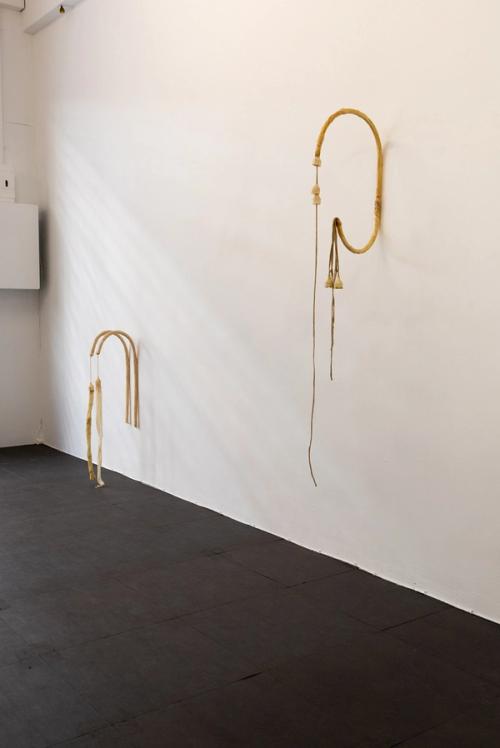
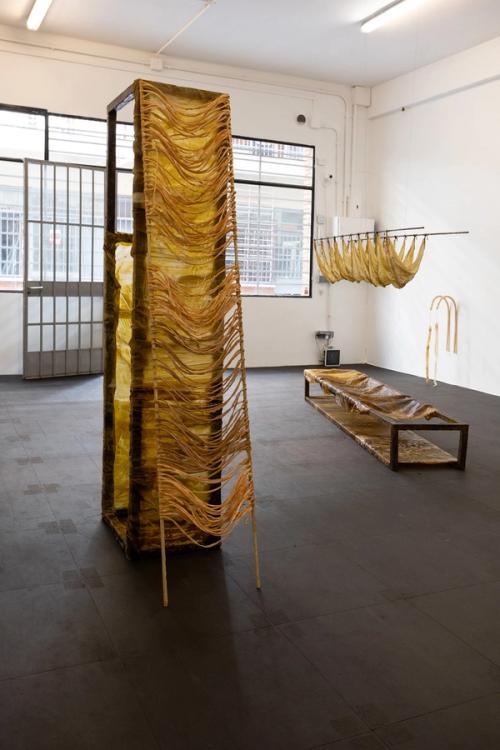
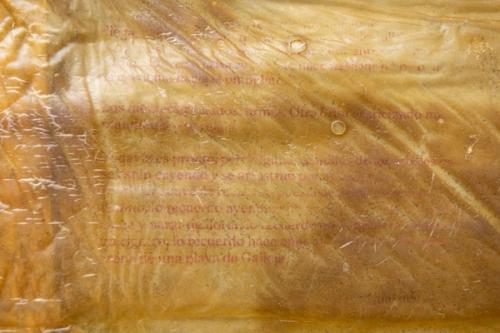
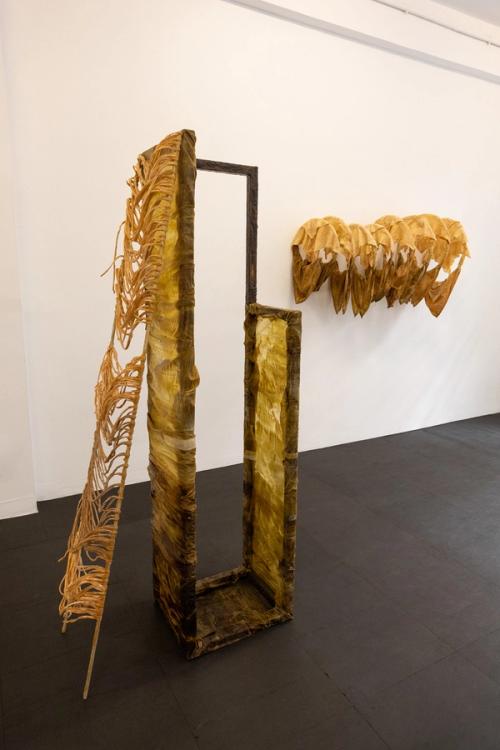
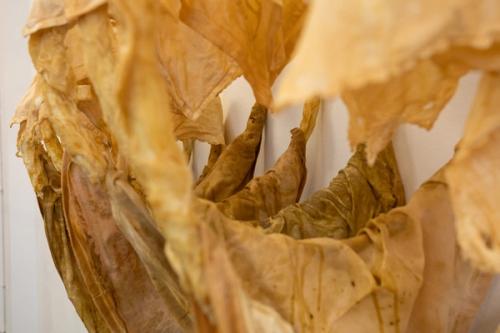
Perhaps this is why her materials always seem on the verge of transformation. Materials that soften, stretch, are sewn, folded, concealed or expanded; structures that always seem to exist between one thing and another, between body and architecture, between object and organism. For this exhibition, Maya has worked with latex, textile, plastic, multilayer pipe, rockrose infusion and copper.
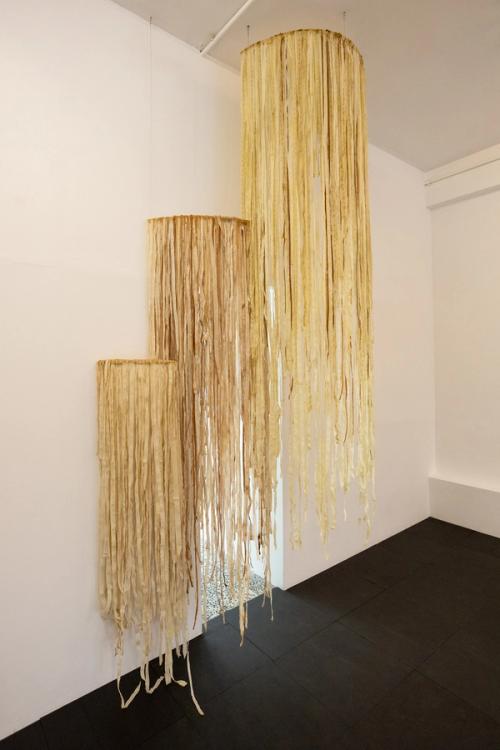
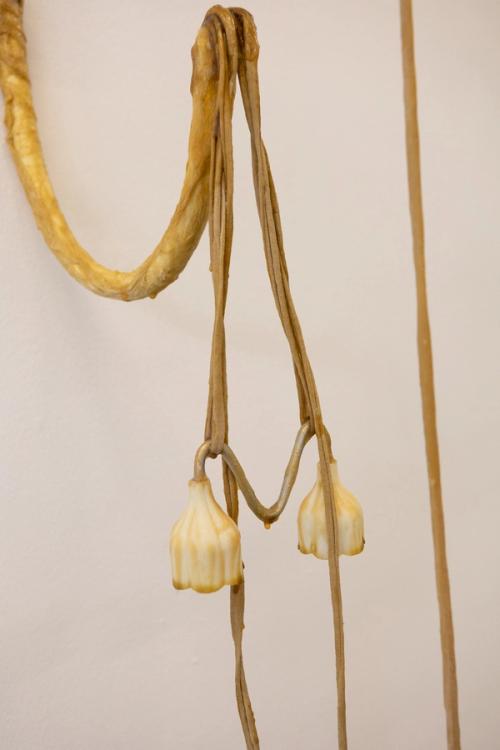
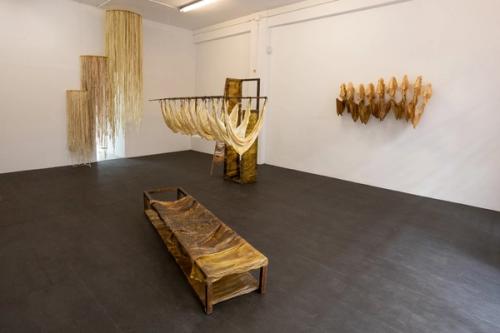
The exhibition features objects and devices that evoke the domestic space and its rituals through household textiles, curtains and their obsolete ornamental weights, tables, and elements associated with shared meals and family and social gatherings. Apparently gentle objects which, in turn, form part of the small choreographies through which we learn to occupy a place, to behave. The home is not only the space where these norms are reproduced: it is one of the first places where they are learned and internalised.
In Caliban and the Witch, Silvia Federici showed how the family and the domestic sphere have historically constituted fundamental spaces for the organisation and naturalisation of the sexual division of labour and the reproduction of life. From another position, Audre Lorde insisted that structures of domination do not remain outside our bodies, but are learned, internalised and reproduced from an early age, also through education and everyday relationships. The home thus appears as a place of transmission: it is where we learn how much space a body can occupy, what must be hidden, what can be said, which forms of affection are legitimate, and what is expected of a girl, a boy, a woman.
In Maya’s works, these objects do not entirely abandon the functions assigned to them; rather, they stretch them and take them somewhere else. The curtain continues to conceal, but also becomes a mechanism; the household textile retains the memory of a social structure, but can be manipulated and reorganised; the table maintains its status as a domestic space while its uses and relationships are transformed. It is therefore not a matter of opposing care and violence, but of observing the extent to which both can form part of the same gesture.
This ambivalence also runs through her relationship with the wound. The wound does not appear as an exceptional condition that must be repaired, but as an operation upon the body: opening, scraping, stitching, covering, extracting, opening again. Hence the recurring presence of skin, staples, needles, mouths and devices that intervene upon bodies. And hence the rockrose too: a plant whose resin heals and which, at the same time, burns; a material that reaches the human body after having passed through the animal body.
In this displacement, Chiron—the wounded healer—functions less as a figure of redemption than as a productive contradiction: the one who heals is also the one who bears the wound. The exhibition situates itself there: not in repair, but in the operations we perform upon bodies, objects and forms of life in order to make them habitable once again.
Maya started telling me about the gum rockrose. I love it when stories have flowers and plants as almost central protagonists, in the recurring manner of Greco-Roman myths or folk tales from different cultures. Maya looks at the rockrose and, through her attention to it, shares with me the intuitions that have taken her from one place to another, gradually building stories around them.
The gum rockrose (Cistus ladanifer) is characteristic of the warm, dry, siliceous soils of the Sierra de Madrid, where Maya spent part of her childhood. An apparently fragile plant, with white, wrinkled flowers, like cigarette paper, whose individual blooms last only briefly, yet which, taken together, transform the landscape into something that appears snow-covered. Its petals are marked by five reddish spots, which have given it one of its most popular names: the five-wound rockrose.
The rockrose is resinous and flammable. It is linked to fire and poor soils, to survival and shepherding. It burns easily and, at the same time, the heat from fires facilitates the germination of its seeds. It burns in order to return. It is precisely where the landscape seems to have been destroyed that it can most easily come back. As we write this text, the western Sierra of Madrid is burning mercilessly.
There is another story about the rockrose that is particularly fruitful for Maya. Its resin produces labdanum, an aromatic substance that was used for centuries in perfumes, incense and medicinal preparations. Maya shares with me the fascinating image of an old, oversized comb, a rudimentary tool used to extract labdanum from the tangle of the rockrose scrub. Traditionally, labdanum could also be collected from the wool of sheep and goats, which, while grazing among the rockrose bushes, would become coated in the sticky substance. There is something in this object and in these gestures that condenses many of the questions running through her practice: the relationship between human and non-human bodies, between care and extraction, between tenderness and violence; but also between knowledge and experience. A form of knowledge that emerges from the hands, from the repetition of a gesture, from observing what happens when one body comes into contact with another.
In the images Maya shared with me throughout the process, there was an open mouth, forced apart by hooks holding its edges so that its interior could be observed: the teeth, palate, tongue, tonsils, uvula. In another, an animal’s body appears partially shaved so that a wound can be stitched. In another, hands are wrapped in strips of white material, crossed by arrows and annotations. Later, one hand holds a sticky substance between the index finger and thumb; around it are syrups, sweet syrups and candies. And in another open mouth, hands perform the gesture of stretching it apart while, inside, there is a flower, a sprig of herbs and a pair of scissors. The mouth thus becomes a strange place: organ, opening, wound, entrance, exit. A place where the bodily and the vegetal, the medicinal and the domestic, nourishment and surgery become entangled.
It is no coincidence that the titles of Maya’s earlier works repeatedly invoke the mouth, the tongue, the body: sin nunca llegar a la boca, mil caricias saben a golpe, Una lengua cansada, desde dentro parece que brota algo, lamer un tallo cortado, marañas que lamen mi piel. In them, there is an insistence on knowing through the body, before language organises experience.
Perhaps this is why her materials always seem on the verge of transformation. Materials that soften, stretch, are sewn, folded, concealed or expanded; structures that always seem to exist between one thing and another, between body and architecture, between object and organism. For this exhibition, Maya has worked with latex, textile, plastic, multilayer pipe, rockrose infusion and copper.
The exhibition features objects and devices that evoke the domestic space and its rituals through household textiles, curtains and their obsolete ornamental weights, tables, and elements associated with shared meals and family and social gatherings. Apparently gentle objects which, in turn, form part of the small choreographies through which we learn to occupy a place, to behave. The home is not only the space where these norms are reproduced: it is one of the first places where they are learned and internalised.
In Caliban and the Witch, Silvia Federici showed how the family and the domestic sphere have historically constituted fundamental spaces for the organisation and naturalisation of the sexual division of labour and the reproduction of life. From another position, Audre Lorde insisted that structures of domination do not remain outside our bodies, but are learned, internalised and reproduced from an early age, also through education and everyday relationships. The home thus appears as a place of transmission: it is where we learn how much space a body can occupy, what must be hidden, what can be said, which forms of affection are legitimate, and what is expected of a girl, a boy, a woman.
In Maya’s works, these objects do not entirely abandon the functions assigned to them; rather, they stretch them and take them somewhere else. The curtain continues to conceal, but also becomes a mechanism; the household textile retains the memory of a social structure, but can be manipulated and reorganised; the table maintains its status as a domestic space while its uses and relationships are transformed. It is therefore not a matter of opposing care and violence, but of observing the extent to which both can form part of the same gesture.
This ambivalence also runs through her relationship with the wound. The wound does not appear as an exceptional condition that must be repaired, but as an operation upon the body: opening, scraping, stitching, covering, extracting, opening again. Hence the recurring presence of skin, staples, needles, mouths and devices that intervene upon bodies. And hence the rockrose too: a plant whose resin heals and which, at the same time, burns; a material that reaches the human body after having passed through the animal body.
In this displacement, Chiron—the wounded healer—functions less as a figure of redemption than as a productive contradiction: the one who heals is also the one who bears the wound. The exhibition situates itself there: not in repair, but in the operations we perform upon bodies, objects and forms of life in order to make them habitable once again.