murmur
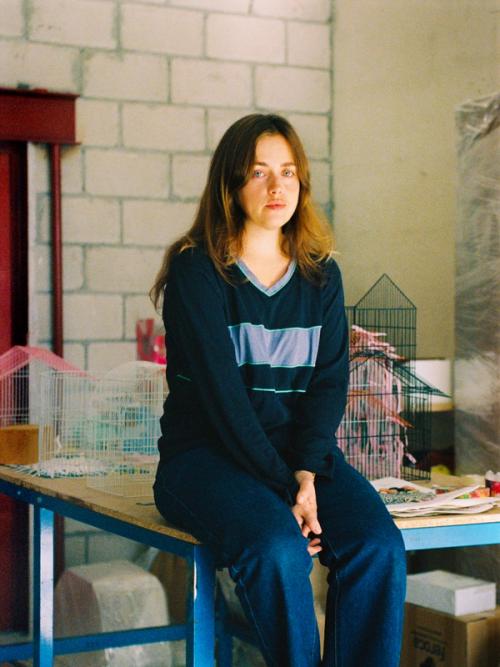
Solo show by Esther Merinero
murmur
Solo show by Esther Merinero
17 September - 17 October 2026
Credits
Cristina Anglada
Diego Beyró
Location
Thursdays and Fridays
15:00 – 19:00
Saturdays
12:00 – 15:00
There’ll be turbulence. You’ll drop
your book to hold
your water bottle
steady. Your
mind, mind has mountains, cliffs of
fall may who ne’er hung there let
him watch the movie. The plane’s
supposed to shudder, shoulder
on like this. It’s built to do that.
You’re designed to tremble too.
Else break Higher you climb,
trouble in mind lungs labor,
heights hurl vistas
Oxygen hangs
ready overhead. In the
event put on
the child’s mask first. Breathe normally
Turbulence. Adrienne Rich
Murmur, whisper, mutter, hiss, babble, rumour. A low, continuous, indistinct sound. It occurs when several voices speak without raising themselves or when something —air, water, matter— grazes and shifts. The murmur disperses meaning and is charged with matter. It appears when words overlay, when they lose precision. A murmur is also the sound produced when telling a secret. People speaking softly to generate a temporary intimacy and create certain encrypted language.
Esther Merinero’s work is situated in that area of friction where the need and impulse to say coexist with the frustration of definitions and the harshness of language. Words emerge urgently, yet insufficiently: they fail to translate the density of experience and its emotion. Faced with this incompatibility, the murmur appears as a way of insisting without fixing, of sustaining ambiguity.
Murmur is also the title of this exhibition. The show is structured around three axes—speech, transit, and memory—which intertwine through a series of sculptures and images functioning as poetic devices. They do not illustrate an idea nor narrate an event: they suggest, contain, and allow passage.
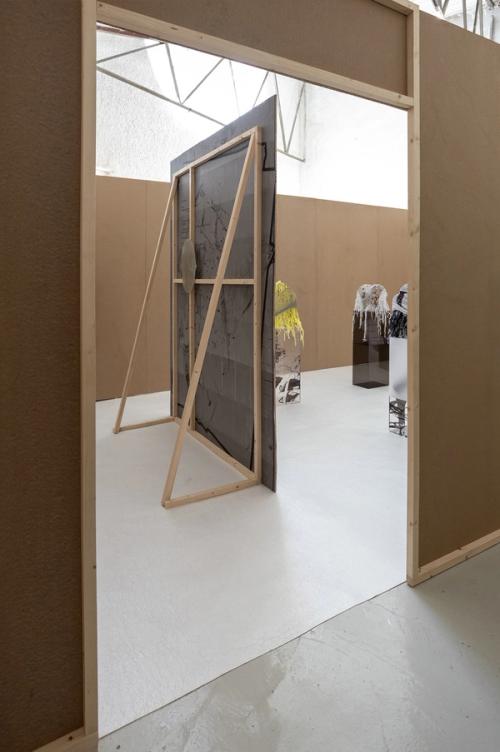
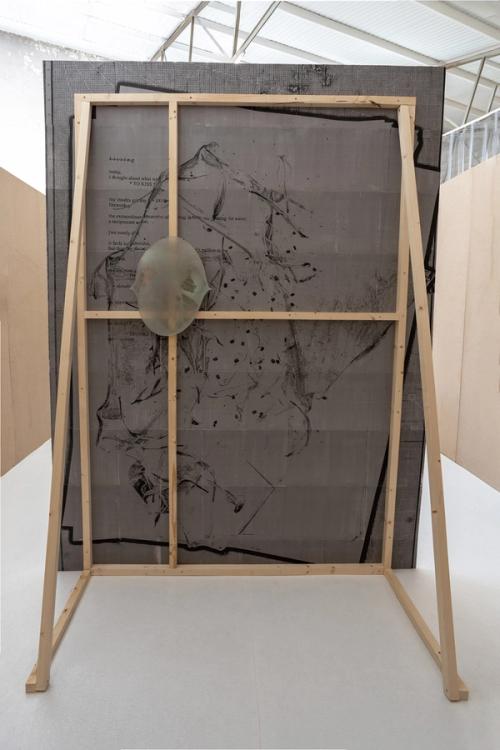
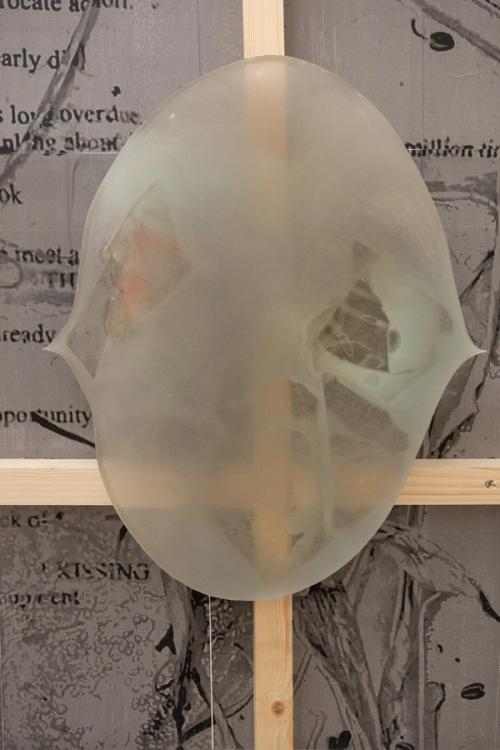
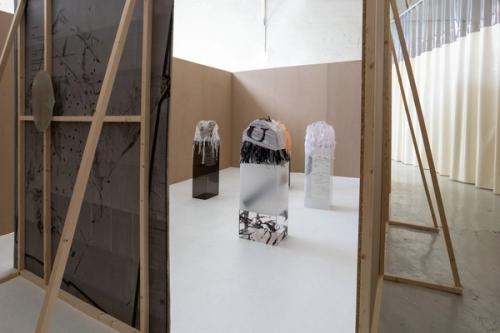
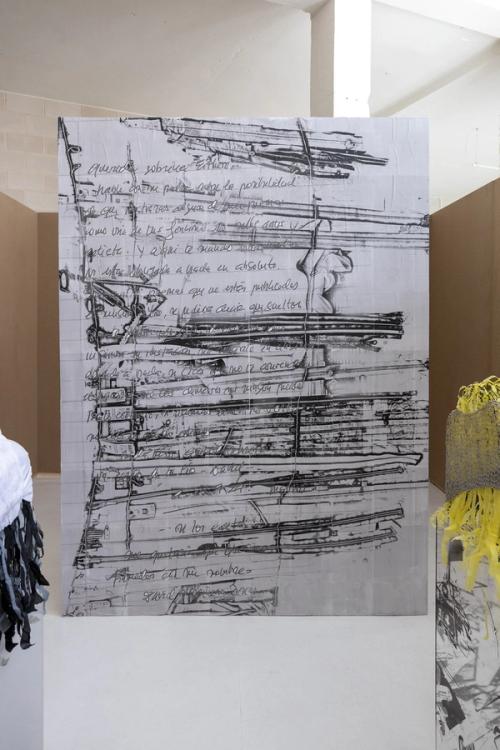
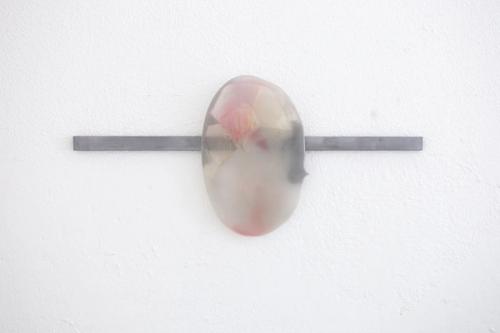
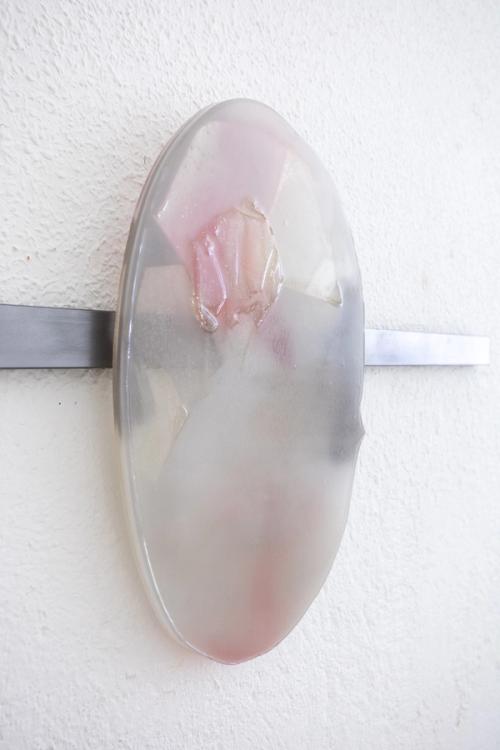
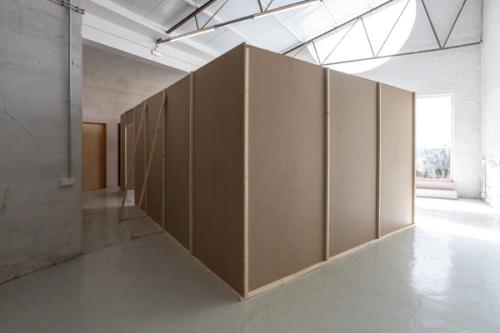
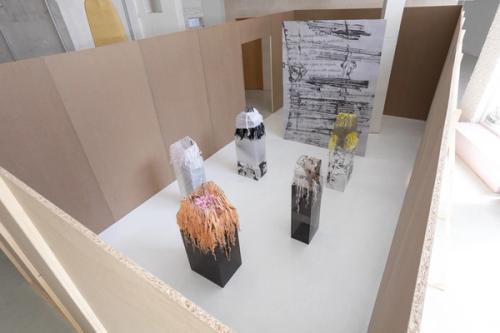
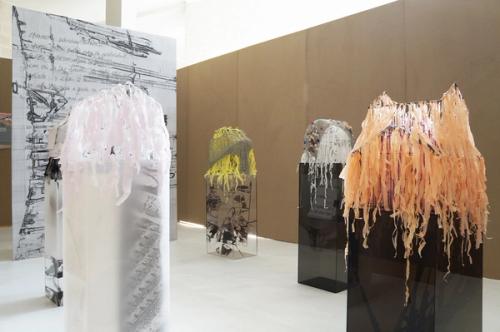
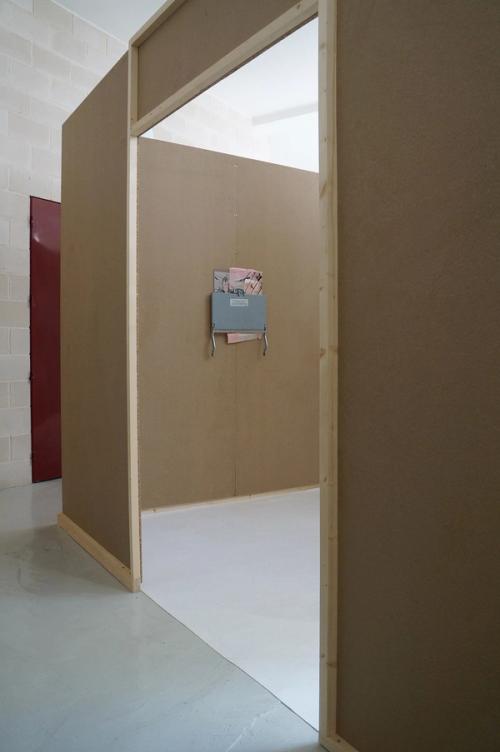
Upon entering the room, we are greeted by a large wall-printed black-and-white image with a grainy quality close to that of a scanner. In it, fragments of words, kisses, and opaque images flatten into two dimensions, coexisting like a visual murmur. Over this surface a resin object is superimposed, functioning as a kind of punctuation mark: pause, bubble, accent. It does not speak, but it highlights; it does not explain, but opens intervals so that communication can breathe. The whole image operates as a surface of sedimentation, a place where different temporalities accumulate and coexist. Its appearance recalls forms of involuntary recollection, such as the images recorded by cameras attached to carrier pigeons at the beginning of the 20th century: explorations without aesthetic intention, produced by bodies in transit.
Latent images that do not narrate but preserve; that do not fix but leave a trace. Remains that murmur.
Transit runs through the exhibition subtly yet constantly. It appears in the idea of flight, of moving through air, of suspended waiting times. In the air, demands dissolve and attention folds back toward memory, desire, and expectation. To fly implies separating and merging at once: leaving behind and anticipating, inhabiting an interval where nothing fully settles.
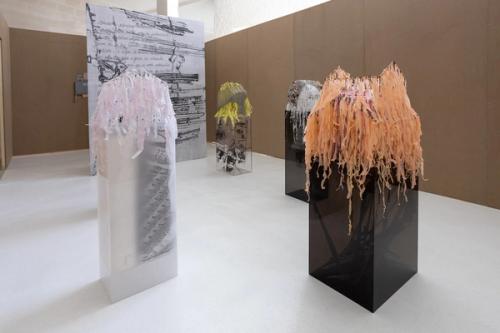
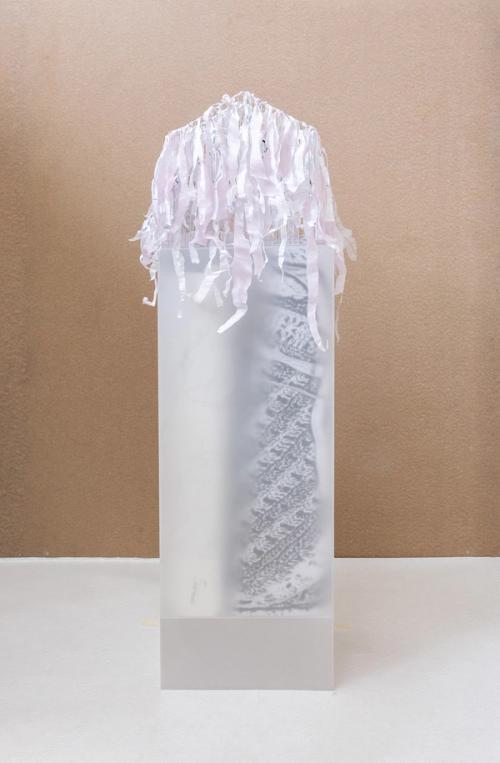
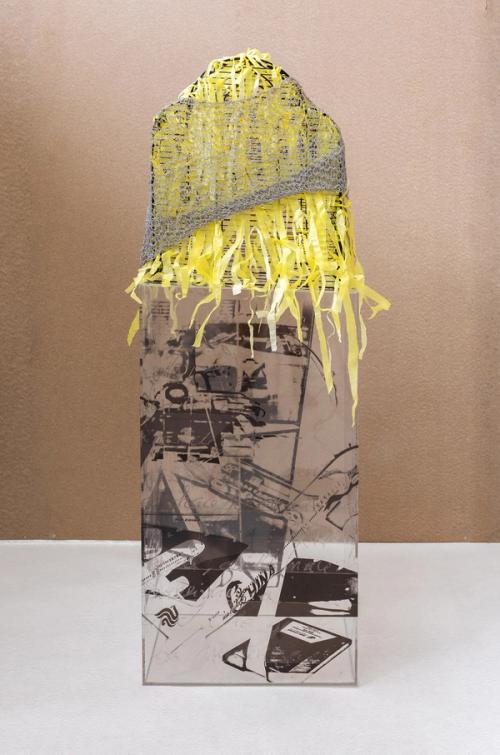
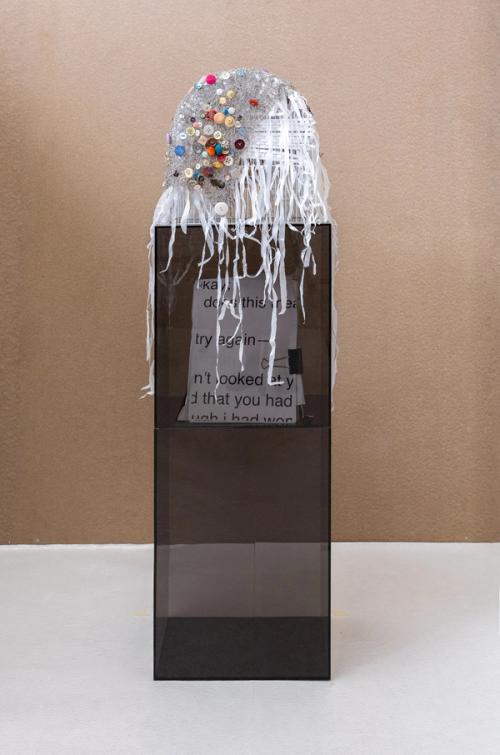
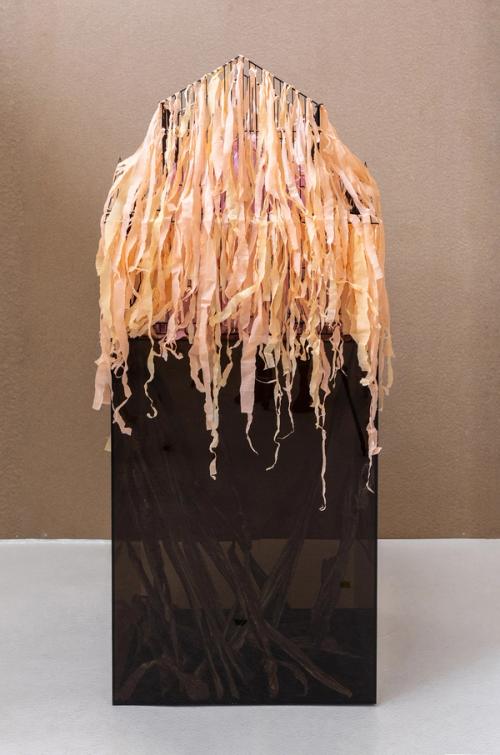
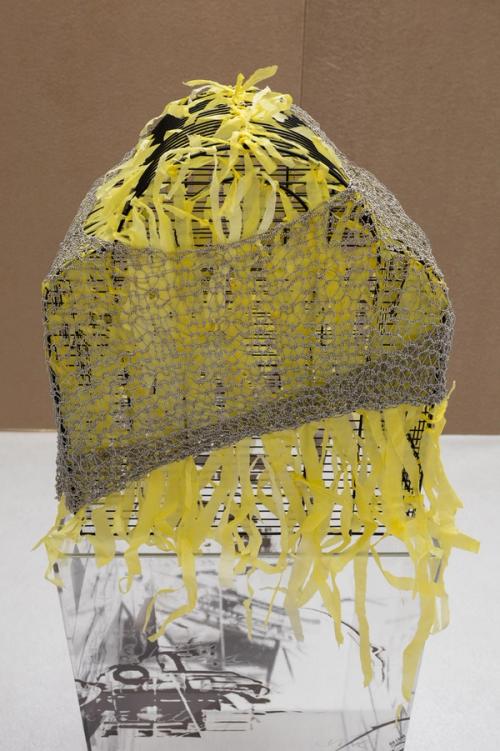
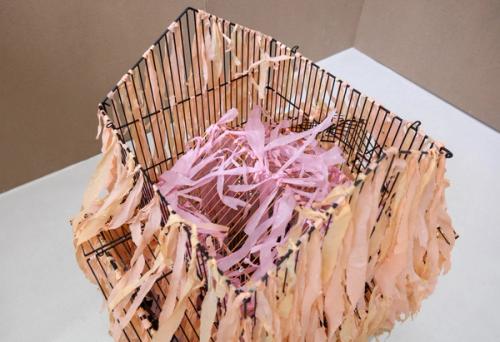
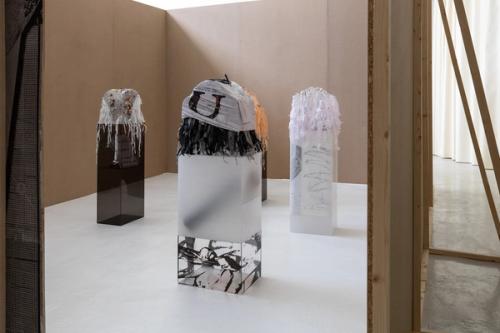
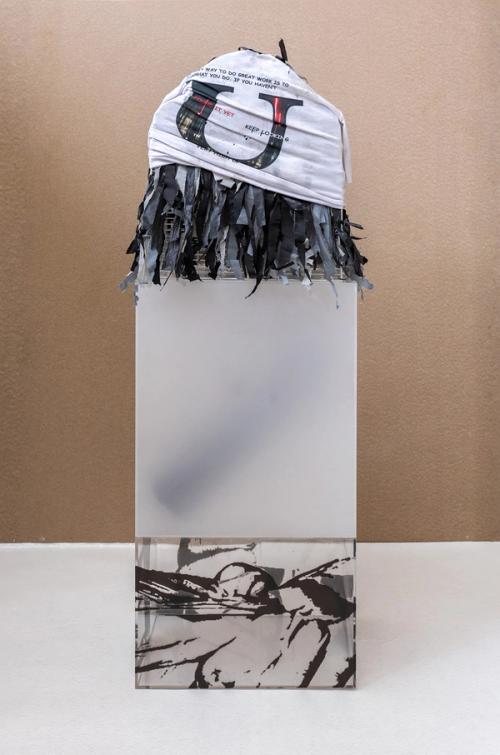
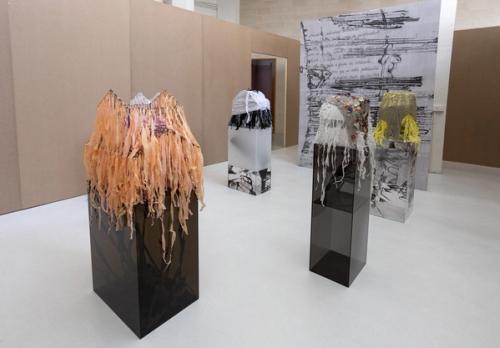
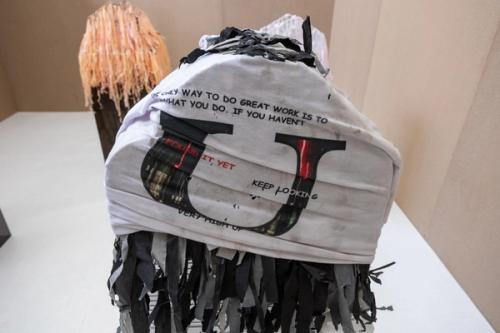
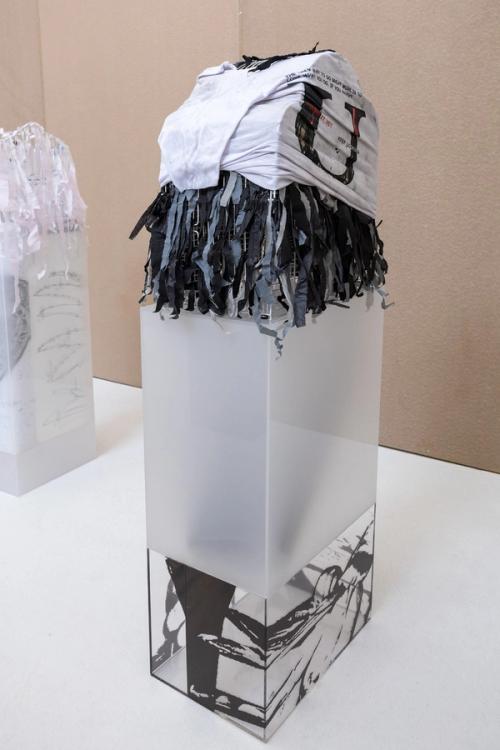
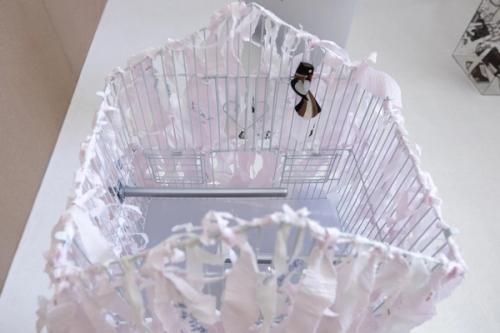
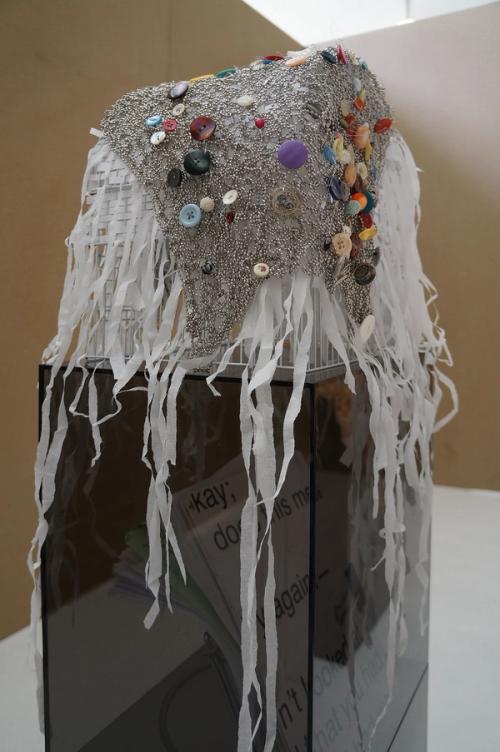
Behind the wall, we encounter a group of sculptural pieces composed of fragments of already existing objects and fragile materials. Tissue-paper locks—yellow, white, black, lilac, salmon- colored—formed by strips that tremble slightly as bodies pass around them. On these porous and lightweight surfaces, in some cases, a mesh or metallic chain shirt is superimposed, and in another, a white T-shirt searching for meaning. All of this envelops a metal carcass that once served as a domestic cage for animals that should not have been caged. The cage is rescued here in a gentler way, as parts of its closures are no longer so, and they appear roofless and/or without a door. These upper amalgams rest on pedestals of different heights that, far from affirming a solid base, reveal themselves hollow and semi-transparent. Containers that do not hide their interior, but veil it. Emptiness becomes an active presence: a space available for something to occur from what it contains, or from what covers it. Superimposition, fragment, coexistence: elements that do not seek to merge, but to sustain one another.
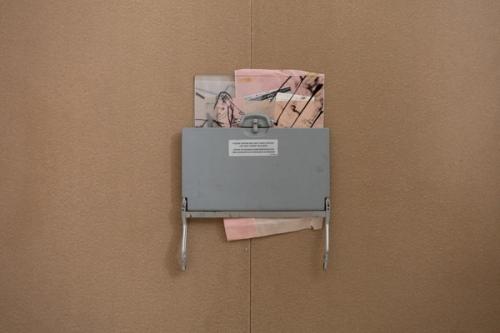
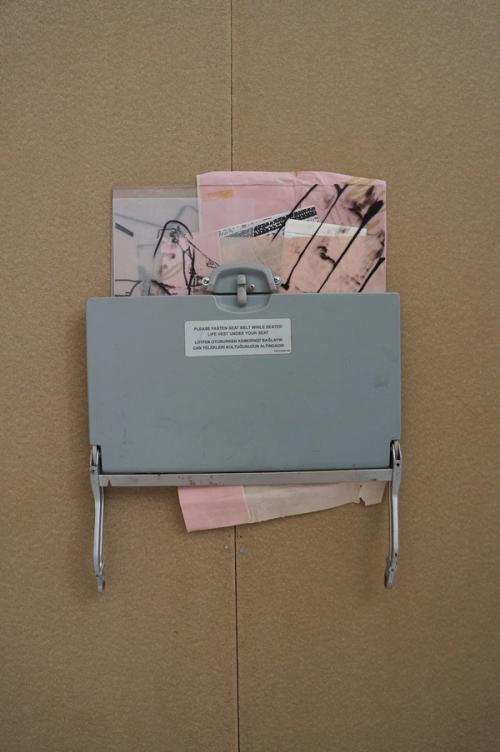
Esther works with the accumulation of personal objects and archival images driven by the same impulse: the need to sustain memory through what has been charged with emotion. Her photographic archive gathers urban and everyday remains where the festive and the lingering coexist and the event has already passed. A similar exercise is carried out with the objects she preserves/keeps (keys, postcards, locks of hair, letters, flowers, handkerchiefs, shoes, …), which function as fragments of lived experience. Far from neutral, these elements act as surfaces of memory: they condense nostalgia, vulnerability, longing, and desire, and assume— sometimes almost celebratorily—the ephemeral and mortal condition of experience.
They belong to the realm of the commonplace, and it is from this familiarity and strangeness that they activate their potency. Their language is not semantic but emotional: rather than being passively contemplated, they offer themselves as agents that insinuate or resist, summoning a form of communication that does not pass through speech or writing, but through contact with one’s own experience of being alive. This affective accumulation does not respond to a logic of order or classification, but to the desire to retain, care for, and not let go. Disorder is thus sustained as a necessary condition for memory to remain active, open, and in motion. The relationship with objects directly refers to the way memory is constructed affectively: what is kept, what matters, what is preserved for intimate rather than heroic reasons.
The need to preserve appears linked to the fear of loss, to the fact of not being prepared for the end. In a culture that tends to evade death, these gestures open the possibility of imagining other forms of relationship with absence. In this sense, the exhibition dialogues with the proposals of Vinciane Despret, for whom the dead are not closed absences, but presences that continue participating in our affective and relational life.
Speech—or its difficulty—pierces through the exhibition from beginning to end. The word appears as a malleable matter, capable of hiding, protecting, or transmitting meaning without fully exposing itself. The murmur operates as an affective technology: it protects the one who speaks and, at the same time, summons the one who listens. Not everything is revealed; something remains veiled in order to activate the desire to understand and keep imagination, intuition, and speculation alive.
To think of language as enchantment—spell (to spell, to write, to enchant)—allows us to situate Esther’s work within a tradition of practices that operate through repetition, accumulation, and detour, rather than direct affirmation. As in texts that understand the poem, the weave, or the knot as technologies of memory, here meaning is not fixed, but reactivated again and again. In the essay Blandito Blandito, blanca arias turns to the history of enslaved weavers to think about these forms of silent resistance: sewing and weaving as spaces of transmission, as soft archives where messages, routes, and affections are encoded. Quilts function as narrative and mediumistic surfaces, capable of dragging presences from the past into the present, altering linear time and turning it into a loop, a circle, a vibration that insists.
From this logic, Esther’s work can be read as a practice of material enchantment: objects, images, and gestures that cushion, envelop, and sustain. Like spell-poems, her pieces register memory in order to reorder it and make it breathable, returning it to the body. This way of working distrusts hardness, clarity, and assertion, and instead, it commits to intimacy, repetition, vulnerability, and affect as modes of resistance and care.
your book to hold
your water bottle
steady. Your
mind, mind has mountains, cliffs of
fall may who ne’er hung there let
him watch the movie. The plane’s
supposed to shudder, shoulder
on like this. It’s built to do that.
You’re designed to tremble too.
Else break Higher you climb,
trouble in mind lungs labor,
heights hurl vistas
Oxygen hangs
ready overhead. In the
event put on
the child’s mask first. Breathe normally
Turbulence. Adrienne Rich
Murmur, whisper, mutter, hiss, babble, rumour. A low, continuous, indistinct sound. It occurs when several voices speak without raising themselves or when something —air, water, matter— grazes and shifts. The murmur disperses meaning and is charged with matter. It appears when words overlay, when they lose precision. A murmur is also the sound produced when telling a secret. People speaking softly to generate a temporary intimacy and create certain encrypted language.
Esther Merinero’s work is situated in that area of friction where the need and impulse to say coexist with the frustration of definitions and the harshness of language. Words emerge urgently, yet insufficiently: they fail to translate the density of experience and its emotion. Faced with this incompatibility, the murmur appears as a way of insisting without fixing, of sustaining ambiguity.
Murmur is also the title of this exhibition. The show is structured around three axes—speech, transit, and memory—which intertwine through a series of sculptures and images functioning as poetic devices. They do not illustrate an idea nor narrate an event: they suggest, contain, and allow passage.
Upon entering the room, we are greeted by a large wall-printed black-and-white image with a grainy quality close to that of a scanner. In it, fragments of words, kisses, and opaque images flatten into two dimensions, coexisting like a visual murmur. Over this surface a resin object is superimposed, functioning as a kind of punctuation mark: pause, bubble, accent. It does not speak, but it highlights; it does not explain, but opens intervals so that communication can breathe. The whole image operates as a surface of sedimentation, a place where different temporalities accumulate and coexist. Its appearance recalls forms of involuntary recollection, such as the images recorded by cameras attached to carrier pigeons at the beginning of the 20th century: explorations without aesthetic intention, produced by bodies in transit.
Latent images that do not narrate but preserve; that do not fix but leave a trace. Remains that murmur.
Transit runs through the exhibition subtly yet constantly. It appears in the idea of flight, of moving through air, of suspended waiting times. In the air, demands dissolve and attention folds back toward memory, desire, and expectation. To fly implies separating and merging at once: leaving behind and anticipating, inhabiting an interval where nothing fully settles.
Behind the wall, we encounter a group of sculptural pieces composed of fragments of already existing objects and fragile materials. Tissue-paper locks—yellow, white, black, lilac, salmon- colored—formed by strips that tremble slightly as bodies pass around them. On these porous and lightweight surfaces, in some cases, a mesh or metallic chain shirt is superimposed, and in another, a white T-shirt searching for meaning. All of this envelops a metal carcass that once served as a domestic cage for animals that should not have been caged. The cage is rescued here in a gentler way, as parts of its closures are no longer so, and they appear roofless and/or without a door. These upper amalgams rest on pedestals of different heights that, far from affirming a solid base, reveal themselves hollow and semi-transparent. Containers that do not hide their interior, but veil it. Emptiness becomes an active presence: a space available for something to occur from what it contains, or from what covers it. Superimposition, fragment, coexistence: elements that do not seek to merge, but to sustain one another.
Esther works with the accumulation of personal objects and archival images driven by the same impulse: the need to sustain memory through what has been charged with emotion. Her photographic archive gathers urban and everyday remains where the festive and the lingering coexist and the event has already passed. A similar exercise is carried out with the objects she preserves/keeps (keys, postcards, locks of hair, letters, flowers, handkerchiefs, shoes, …), which function as fragments of lived experience. Far from neutral, these elements act as surfaces of memory: they condense nostalgia, vulnerability, longing, and desire, and assume— sometimes almost celebratorily—the ephemeral and mortal condition of experience.
They belong to the realm of the commonplace, and it is from this familiarity and strangeness that they activate their potency. Their language is not semantic but emotional: rather than being passively contemplated, they offer themselves as agents that insinuate or resist, summoning a form of communication that does not pass through speech or writing, but through contact with one’s own experience of being alive. This affective accumulation does not respond to a logic of order or classification, but to the desire to retain, care for, and not let go. Disorder is thus sustained as a necessary condition for memory to remain active, open, and in motion. The relationship with objects directly refers to the way memory is constructed affectively: what is kept, what matters, what is preserved for intimate rather than heroic reasons.
The need to preserve appears linked to the fear of loss, to the fact of not being prepared for the end. In a culture that tends to evade death, these gestures open the possibility of imagining other forms of relationship with absence. In this sense, the exhibition dialogues with the proposals of Vinciane Despret, for whom the dead are not closed absences, but presences that continue participating in our affective and relational life.
Speech—or its difficulty—pierces through the exhibition from beginning to end. The word appears as a malleable matter, capable of hiding, protecting, or transmitting meaning without fully exposing itself. The murmur operates as an affective technology: it protects the one who speaks and, at the same time, summons the one who listens. Not everything is revealed; something remains veiled in order to activate the desire to understand and keep imagination, intuition, and speculation alive.
To think of language as enchantment—spell (to spell, to write, to enchant)—allows us to situate Esther’s work within a tradition of practices that operate through repetition, accumulation, and detour, rather than direct affirmation. As in texts that understand the poem, the weave, or the knot as technologies of memory, here meaning is not fixed, but reactivated again and again. In the essay Blandito Blandito, blanca arias turns to the history of enslaved weavers to think about these forms of silent resistance: sewing and weaving as spaces of transmission, as soft archives where messages, routes, and affections are encoded. Quilts function as narrative and mediumistic surfaces, capable of dragging presences from the past into the present, altering linear time and turning it into a loop, a circle, a vibration that insists.
From this logic, Esther’s work can be read as a practice of material enchantment: objects, images, and gestures that cushion, envelop, and sustain. Like spell-poems, her pieces register memory in order to reorder it and make it breathable, returning it to the body. This way of working distrusts hardness, clarity, and assertion, and instead, it commits to intimacy, repetition, vulnerability, and affect as modes of resistance and care.